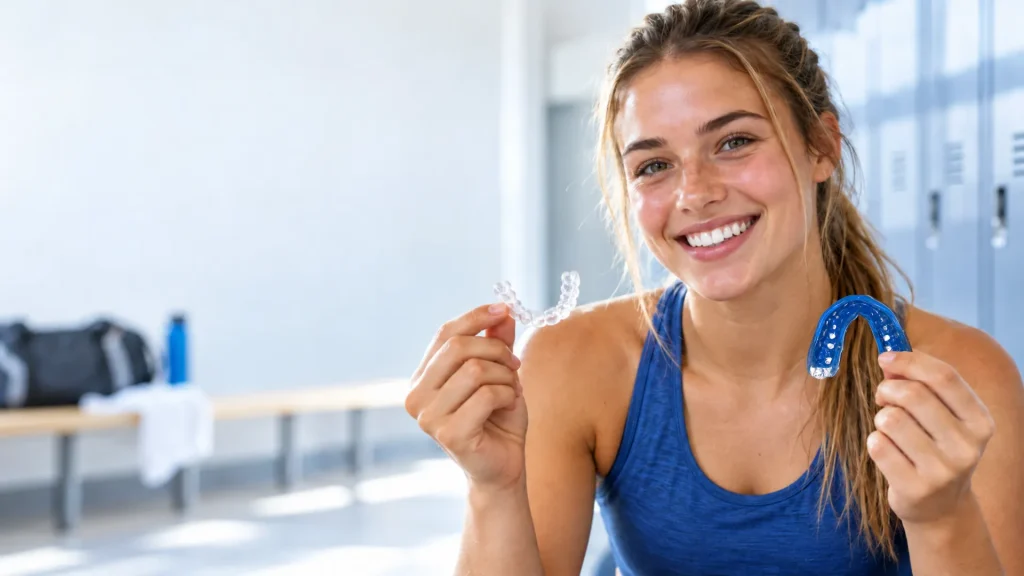
What to look for when protecting your teeth during clear-aligner treatment
By Amanda Trenerry
Originally published February 9, 2024
Clear aligners have made orthodontic treatment far less noticeable, but they can create some confusion when it comes to playing sport.
Can you wear a sports mouthguard during clear-aligner treatment? Should the aligners remain in place? What happens to the attachments bonded to the teeth? And how can a mouthguard continue to fit when the teeth are constantly moving?
The short answer is that you can wear a sports mouthguard during clear-aligner treatment. Unless your treating orthodontist advises otherwise, however, the removable aligners should be taken out before fitting or wearing the mouthguard.
The attachments bonded to the teeth remain in place, so the sports mouthguard needs to fit around the teeth and attachments—not over the removable aligners.
A mouthguard that fits well and holds in place securely is paramount in providing the best protection for all athletes. Athletes with aligners are no exception. A mouthguard that moulds closely around the individual teeth and bonded attachments can provide a secure, comfortable fit while helping protect against dental injuries. This can be achieved with a dental-made mouthguard or a good mouldable “boil & bite” style of mouthguard.
The best sports mouthguard for someone undergoing clear-aligner treatment should therefore provide secure retention, suitable coverage and protection, practical comfort and the ability to accommodate changing tooth positions.
For information covering fixed braces and orthodontic treatment more broadly, see our complete guide to mouthguards for braces.

What are clear aligners and attachments?
Clear aligners are transparent, removable orthodontic appliances made to fit closely over the teeth. They are sometimes called invisible braces or clear plates and are often known by brand names such as Invisalign®, Spark® or 3M Clarity.
Treatment usually involves progressing through a series of aligners. Each aligner is slightly different and applies controlled pressure to guide the teeth towards their planned positions.
Many patients also require attachments. These are small, tooth-coloured shapes bonded directly to selected teeth. They give the aligner an additional gripping point, helping it apply the forces required for particular tooth movements.
The aligners can be removed, but the attachments generally remain bonded to the teeth until the dental practitioner removes them.
This distinction is important when fitting and wearing a sports mouthguard.
Can you wear a sports mouthguard with clear aligners?
Yes, but the removable aligners and bonded attachments must be managed differently.
Unless your dental practitioner or orthodontist provides different instructions, the aligners should be removed before fitting or wearing a sports mouthguard. Clear aligners are designed to move teeth; they are not designed to replace a sports mouthguard or provide protection from sporting impacts.
The attachments remain on the teeth, so the mouthguard needs to be fitted directly around the teeth and attachments.
The usual process is to:
- remove both the upper and lower clear aligners;
- store them safely in their aligner case;
- insert the sports mouthguard directly over the teeth and bonded attachments;
- remove and clean the mouthguard after sport; and
- clean your teeth, where possible, before replacing the aligners.
Some treating practitioners may advise leaving the lower aligner in place when wearing an upper sports mouthguard, while others recommend removing both aligners. Always follow the advice of your treating practitioner, particularly if you have unusual attachments, elastics or other orthodontic components.
A secure, custom-like fit
A sports mouthguard should fit securely enough to remain in position without the athlete continually clenching or biting down.
This is particularly important during clear-aligner treatment. Although aligner attachments are much smaller than conventional orthodontic brackets, they alter the surface of the teeth and need to be accommodated within the mouthguard.
Some pre-formed mouthguards have large orthodontic channels to accommodate braces. These however often provide more space than an aligner patient actually needs. Excessive space can affect retention because the mouthguard will not conform closely to the individual teeth and attachments.
A mouldable mouthguard provides another option by forming around the athlete’s current tooth positions and bonded attachments, however, not every mouldable mouthguard is approved for orthodontic use. Before fitting one, confirm that its manufacturer identifies it as suitable for bonded attachments and provides appropriate fitting and removal instructions.
The ability to re-mould as teeth move
Tooth movement is the purpose of clear-aligner treatment. As the athlete progresses through the prescribed series of aligners, their tooth positions gradually change.
This means that a mouthguard fitted near the beginning of treatment is unlikely to fit comfortably several months later.
Signs that the fit may need to be reviewed include:
- the mouthguard no longer seating fully;
- increasing pressure on particular teeth or attachments;
- the mouthguard feeling unusually tight or loose;
- reduced retention;
- discomfort that was not present previously; or
- changes to the orthodontic attachments or treatment plan.
A mouthguard designed for repeated re-moulding can be intentionally reheated and fitted around the new tooth positions. This helps maintain a closer fit as orthodontic treatment progresses.
Not every mouth-formed mouthguard can be safely re-moulded multiple times, so always check the manufacturer’s instructions.
Our article about how a re-mouldable mouthguard adapts as teeth move explains this process in more detail.
Suitable thickness and protection
Thickness is one factor affecting how a mouthguard behaves during an impact, but it should not be considered in isolation.
The materials, construction, fit, coverage and ability of the mouthguard to remain securely in position also contribute to its overall protective function.
A mouthguard must provide sufficient material around the teeth and surrounding structures without becoming unnecessarily bulky. Excessive bulk can affect comfort, speech and breathing and may make an athlete less willing to wear the mouthguard consistently.
This balance becomes particularly important during orthodontic treatment because the mouthguard also needs to accommodate attachments and changing tooth positions.
Comfort and wearability
A sports mouthguard can only provide protection while it is being worn.
Comfort is therefore more than a matter of personal preference. If a mouthguard feels excessively bulky, continually dislodges, interferes with breathing or irritates the lips and cheeks, an athlete is more likely to remove it during training or competition.
Look for a mouthguard that:
- feels smooth against the lips, cheeks and tongue;
- remains securely in position;
- does not require constant clenching;
- allows practical speech and breathing;
- avoids unnecessary bulk; and
- does not contain hard, non-mouldable sections that sit poorly around the individual teeth or attachments.
The athlete should still expect to be aware that they are wearing a mouthguard. The aim is not to make the product imperceptible, but to achieve an appropriate balance between fit, protection and practical wearability.
Fitting around bonded attachments
A mouthguard for an aligner patient must be fitted around the attachments that remain bonded to the teeth.
It should form closely enough to provide retention without placing unnecessary pressure on them.
Follow orthodontic fitting and removal instructions carefully. If the manufacturer requires additional space or a protective barrier, that step should not be omitted.
Do not force a mouthguard into position or pull aggressively if it does not release normally. If it feels caught around an attachment, follow the manufacturer’s removal directions and seek professional advice if required.
The mouthguard should not interfere with treatment
A mouthguard worn during orthodontic treatment should not place unnecessary pressure on the teeth, attachments or other orthodontic components.
It should be checked regularly because a fit that was appropriate when the mouthguard was first moulded may change as treatment progresses.
Speak with your orthodontist or dental practitioner if:
- the mouthguard places noticeable pressure on individual teeth;
- it no longer seats completely;
- it becomes difficult to insert or remove;
- an attachment repeatedly loosens or becomes damaged;
- new attachments or components have been added;
- the treatment plan has changed; or
- you are uncertain whether the mouthguard is affecting treatment.
Athletes with complex dental conditions or unusual appliances may require individual assessment and a professionally made solution.
Dental-made mouthguards during clear-aligner treatment
A professionally made mouthguard may be suitable during clear-aligner treatment and remains an important option for athletes requiring individual clinical assessment.
A dental-made mouthguard is produced from an impression or digital record of the teeth at a particular stage of treatment. The clinician or technician may incorporate space for attachments and anticipated tooth movement where appropriate.
Once fabricated, however, the mouthguard remains in the shape created from that original record. It cannot ordinarily be reheated and re-fitted by the wearer as tooth positions change.
As treatment progresses, the original spaces remain within the mouthguard and the fit may eventually become less closely adapted. The mouthguard may then require professional adjustment or replacement.
A re-mouldable mouthguard offers a different option for athletes who want to update the fit themselves as their teeth move. These are often the go-to option recommended by dental practitioners for people undergoing orthodontic treatment.
Easy cleaning and maintenance
Good oral hygiene is particularly important during clear-aligner treatment because the aligners fit closely over the teeth for much of the day.
After each use:
- rinse the sports mouthguard with cool, fresh water;
- clean it gently using a soft toothbrush with soap and water;
- allow it to dry before placing it in its case;
- store it at room temperature in dry conditions; and
- protect it from direct sunlight, hot water and warm environments such as a car dashboard.
Do not expose a mouldable mouthguard to temperatures exceeding the manufacturer’s instructions because heat may unintentionally alter its fitted shape.
The sports mouthguard and clear aligners should be cleaned separately and stored in their respective cases. If possible, clean your teeth before replacing the aligners after sport.
See our guide on how to clean and care for your mouthguard for more detailed advice.
Where Neomorph fits
Neomorph Prodigy® was originally developed to address the fitting and wearability challenges experienced by athletes undergoing orthodontic treatment.
It was designed to offer a re-mouldable alternative to the dental made mouthguard for adults and young people aged 11 years and over, with or without fixed braces or bonded attachments with aligners.
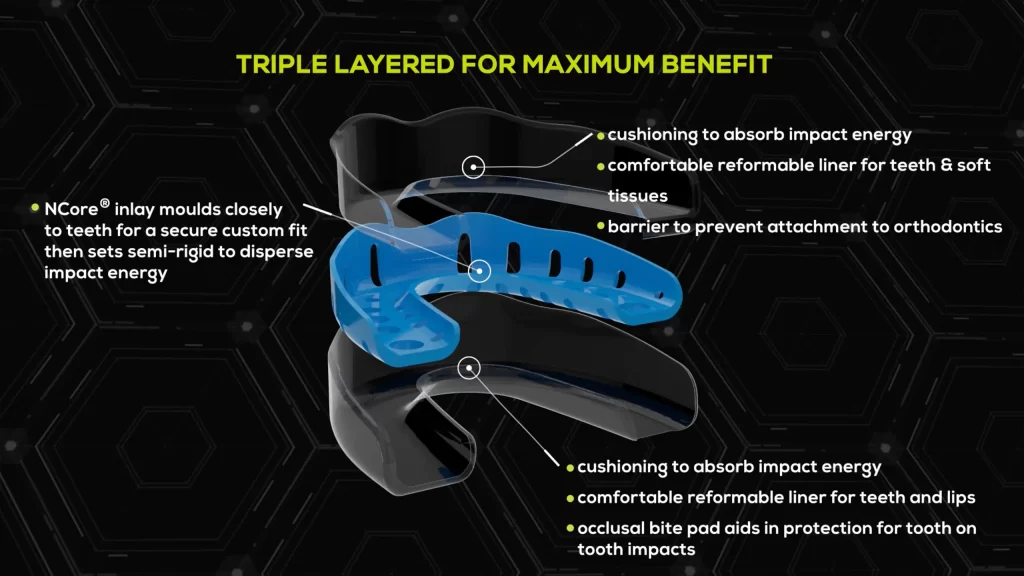
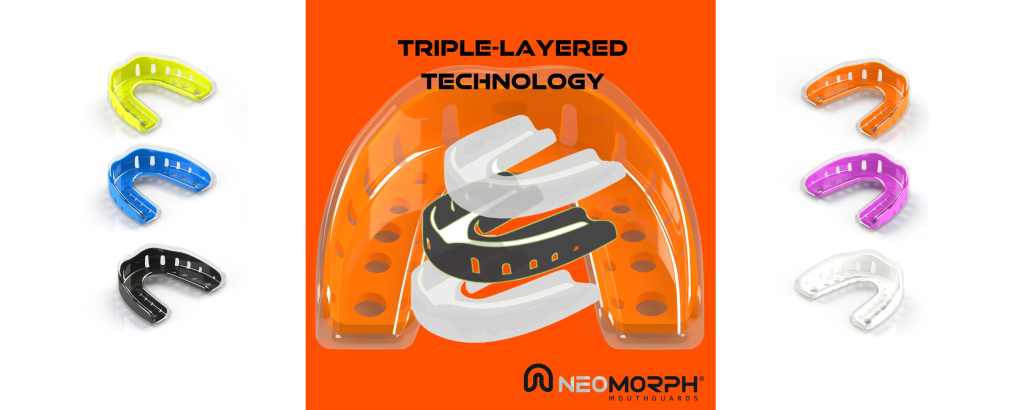
Neomorph uses a fully mouldable, interlocking triple-layer, dual-polymer construction. When heated and moulding for fitting, the NCore® internal layer and softer cushioning material mould together around the teeth and attachments.
Once cooled, NCore® becomes semi-rigid, helping the mouthguard hold its fitted shape and disperse impact energy. Neomorph does not rely on a hard, non-mouldable insert or outer casing.
It can be intentionally reheated and re-moulded up to 10 times, allowing the fit to be updated as the teeth move or attachments change during orthodontic treatment.
The Neomorph Mouthguard is securely fitting, comfortable and protective and can be fitted at home without requiring an impression, digital scan or laboratory fabrication. This makes it an accessible re-mouldable option for athletes who need their mouthguard to accommodate the changing tooth positions associated with clear-aligner treatment.
Ensure you follow the complete Neomorph orthodontic fitting instructions before fitting.
Choosing the right sports mouthguard for clear aligners
The best sports mouthguard for someone undergoing clear-aligner treatment is not necessarily the largest, thickest or most heavily promoted product.
It should:
- be confirmed as suitable for bonded attachments;
- fit directly around the teeth and attachments;
- remain securely in position throughout your time wearing it;
- provide suitable coverage and protection;
- feel comfortable enough to wear consistently;
- allow practical breathing and communication;
- be removable without excessive force; and
- accommodate changing tooth positions throughout treatment.
The removable aligners should ordinarily be taken out before the mouthguard is fitted or worn, while the bonded attachments remain in place.
As the teeth move, check the mouthguard regularly. If it no longer seats correctly, feels unusually tight or loose, or places pressure on the teeth, it may need to be re-moulded, professionally reviewed or replaced.
The right choice depends on the athlete’s individual mouth, treatment and circumstances. When in doubt, consult the orthodontist or dental practitioner responsible for the treatment.
About the Author
Amanda Trenerry is the Founder of NeoMorph Mouthguards and a Dental Hygienist with more than 30 years of clinical experience and over 38 years in the dental profession. Her experience spans across general dentistry, orthodontics, prosthodontics and dental education in both Australia and the UK. Amanda has spent much of her career educating patients about oral health and sports mouthguards and is passionate about improving access to comfortable, protective mouthguards for all athletes.

Disclaimer: This article is based on the professional experience and opinions of Amanda Trenerry, Founder of NeoMorph Mouthguards, gained through more than 30 years working within the dental profession, including extensive experience in orthodontics. The information is provided for educational purposes only and should not be relied upon as individual clinical advice. Patients should consult their own dental or orthodontic practitioner regarding their specific treatment and mouthguard requirements.