In the world of sports and physical activities, a sports mouthguard is a crucial piece of protective gear that stands guard over your teeth to protect them from potential harm. When it comes to selecting the perfect mouthguard, there are many considerations. One of them is the thickness. Thickness is only one consideration when deciding how to choose the right mouthguard. So, just how thick should your mouthguard be?
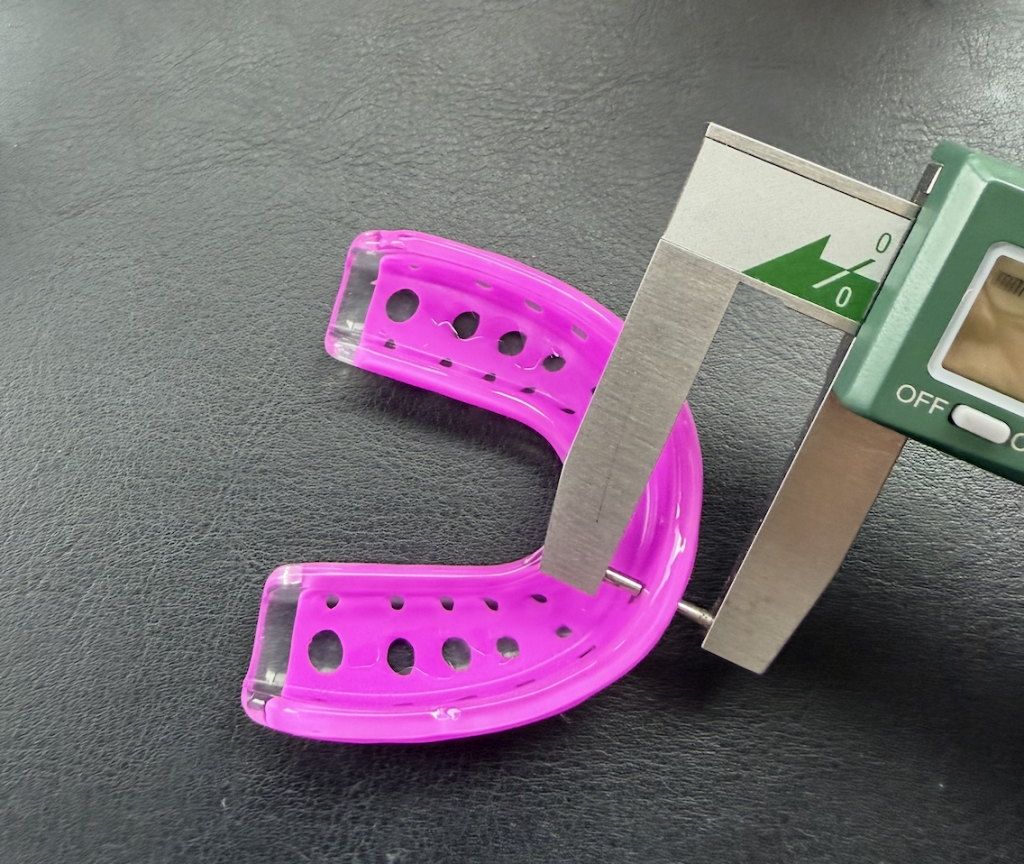
According to the Academy for Sports Dentistry Board of Directors, a good mouthguard should boast ample thickness across all areas to effectively shield against impact forces. Specifically, they recommend a minimum of 3mm thickness on the occlusal (bite) and labial (lip side of front teeth) regions. This thickness is calculated to provide the necessary protection for your teeth and the surrounding tissues, should you take a hit.
The ideal thickness of your mouthguard, however, can depend on a variety of factors, including your personal needs and the type of sport you’re engaged in. For instance, athletes participating in high-impact sports like football or hockey might opt for a thicker mouthguard to up the ante on protection. Conversely, those involved in low-impact activities such as gymnastics might find a thinner mouthguard more comfortable and suitable.
Thickness is just one of several factors that influence mouthguard performance — our complete mouthguard guide to choosing the right mouthguard explains how thickness, fit, and material work together to provide protection.
How Thick Should a Sports Mouthguard Be?
Where is the sweet spot between protection and comfort?
A study titled “EVA mouthguards: how thick should they be?” by Westerman et al. delved into this very question. They found that the thickness of the mouthguard material plays a pivotal role in absorbing energy and distributing forces upon impact. Yet, wearer comfort also remains an equally significant factor. While it’s critical to ensure ample thickness over the incisal edges (biting edge of front teeth) and the cusps of the premolars and back teeth, striking the perfect balance across the entire mouthguard can be quite the challenge.
Ultimately, the research suggests that for an EVA mouthguard material (most dental made mouthguards are made from EVA), a thickness of 4mm at any point where impact is likely to occur strikes a harmonious chord between protection and wearer acceptance. While increasing thickness shows slightly enhanced protection, it can also lead to decreased comfort and user satisfaction.
In conclusion, when it comes to selecting a sports mouthguard, the thickness is a major factor. Striking the right balance between protection and comfort is key. As research suggests, for an EVA mouthguard, a thickness of 4mm at impact-prone areas is a wise choice to safeguard your smile without compromising on your sporting performance or comfort.
Maintaining the correct thickness over time also depends on proper care — learn how to clean and care for your mouthguard to help preserve its shape and performance.
How the Neomorph Mouthguard Performs
The Neomorph Mouthguard is a dual-material, triple-layered mouthguard that is 3.5mm thick. In independent impact testing, 15 of the 16 technician-made dual-layered mouthguards failed before the test rig’s maximum impact. Neomorph reached the maximum without damage in 3 of 4 samples.
Reference: Westerman B, Stringfellow PM, Eccleston JA. EVA mouthguards: how thick should they be? Dental Traumatology. 2002;18(1):24–27.