The Early Days: 1800s Innovation
Have you ever wondered about the origins and history of mouthguards?
The exact origin of the mouthguard isn’t completely clear, but historians have credited its creation to boxers in the 1800’s.
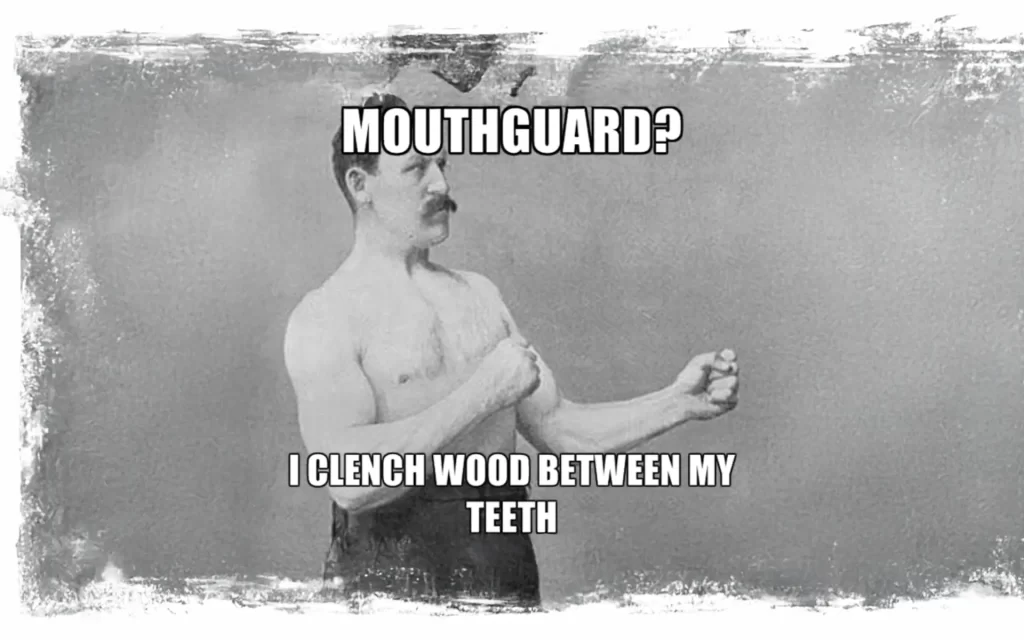
To protect themselves, boxers would bite down on pieces of wood, sponges, wool or tape to protect their teeth from what they would call “rattling” against each other. We would now call that tooth on tooth, or occlusal impact.
The First Formal Mouthguard: 1890s
The first formal attempt at creating a mouthguard appears to be in the 1890s, when a London dentist named Woolf Krause created the “gum shield” from a gutta-percha latex material. Interestingly, Dr Krause’s “gum shields” were intended to protect boxers from lip lacerations more than broken teeth. They were also just a single use product and only held in place by boxers clenching on them.
His son, Philip Krause, a boxer and assistant dentist, later expanded on his father’s design to build a mouthguard out of Vela rubber which allowed it to be more pliable than percha latex. This product had more appeal as it was reusable.
Custom Mouthguards: 1930s-1940s
In 1930 Dr Clarence Mayer documented a way of making custom-made mouthguards. This technique suggested using wax and rubber impressions.
In 1947 a Los Angeles dentist named Rodney O Lilyquist, invented a technique using acrylic resin to form an acrylic mouthguard which fitted the teeth closely, making them less obtrusive and more protective. This invention led to Rodney O Lilyquist being coined the father of “modern mouthguards”.
The Birth of Dental Fabrication: 1950s
In the 1950’s William Godwin worked on vacuum forming Ethylene Vinyl Acetate (or EVA) over casts of athletes teeth. This saw the beginning of dental made mouthguards as we know them today.
It was also around this time that the American Dental Association started to really promote the protective benefits of wearing a mouthguard.
The Boil & Bite Revolution: 1960s
Fast forward to 1960, and Dr AG Jacobs developed the first mouldable “boil & bite” type mouthguard made from EVA, that athletes could form for themselves. This mouldable innovation opened up a whole new era for mouthguards, because they were now accessible to everyone. This greatly increased the success of the formal rule changes that were soon to follow recommending that mouthguards be used for all contact sports.
By 1962, all high school football players in the US were required to wear mouthguards.
Today, the American Dental Association and the International Academy of Sports Dentistry have identified 29 sports and exercise activities where mouthguards are recommended.
History of Mouthguards: Six Decades of EVA Development
Over the last 60 years, we have continued to use Ethylene Vinyl acetate (EVA) for both technician and commercial OTC (over-the-counter) mouldable mouthguards.
We have perfected the dental fabrication procedure for dental technicians through using impressions or scans to make working models of teeth and then vacuum or pressure forming machines to custom fit the material over the models or 3D prints.
We have tried and tested a variety of different polymers (plastics) and have discussed and researched the pros and cons of incorporating hard inserts in mouthguards to disperse impact energy, air spaces in mouthguards to better absorb impact energy and the combination of hard inserts and an air pocket all with the aim of improving a mouthguard’s protective benefits.
We have seen promising results with these variations, with EVA continuing to hold its standing as the “go to” mouthguard material.
Recently, and by that we mean in the last 15 years, a new material has emerged in the medical sector with excellent re-mouldability. It changes shape at a lower temperature yet is substantially stiffer than EVA.
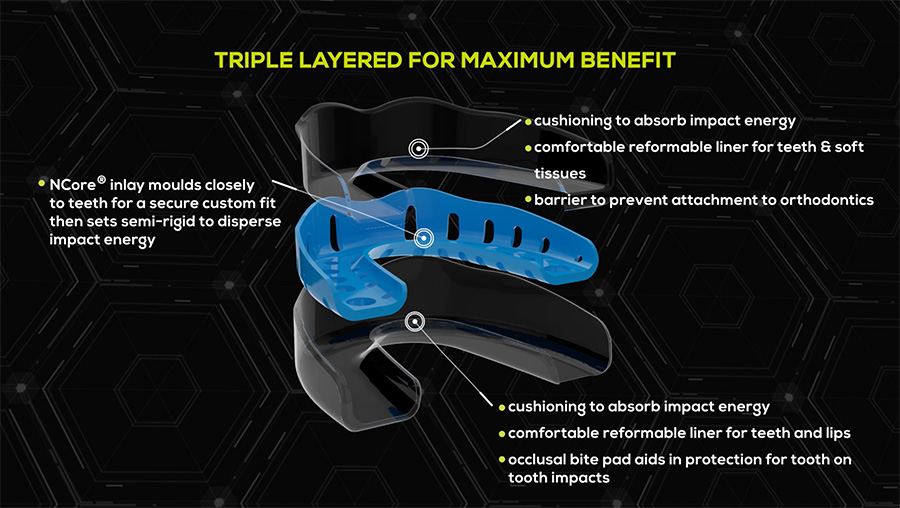
We have embraced the benefits of this new polymer to engineer the inner layer of NeoMorph Prodigy®. We call this NCore®. It is thin, moulds exceptionally well and provides the opportunity to efficiently spread the energy of an impact. That central layer combined with the energy absorption and comfort that Neomorph’s outer and inner EVA layers offer gives us a material combination designed for both comfort and protection.
Neomorph’s unique combination has been examined through independent impact testing under controlled test conditions, where it performed exceptionally well.
The introduction of this new material is what sets Neomorph apart from other re-mouldable mouthguards, and places it in a new category of mouth-formed mouthguard.
NCore® is super mouldable which provides a secure, custom-like fit, comfort, retention and protective quality, allowing the Neomorph Mouthguards’ unique structure to provide a new approach to protection in a mouthguard that is entirely mouldable and has no hard bulky outer casing or hard non-mouldable inserts.
To learn more about mouthguard protection, fit and the different options available, read our complete mouthguard guide.