Why NeoMorph Invested in Independent Sports Mouthguard Impact Testing
At NeoMorph, we believe a mouthguard should do more than simply exist as a piece of protective equipment — it should demonstrate how it performs under controlled impact conditions.
As a dental hygienist working in both general and orthodontic practice, I spent years hearing about the frustration many sports people experienced with poorly fitting and uncomfortable OTC (over-the-counter) mouthguards.
A common issue with many traditional OTC mouthguards is that protection, comfort, fit, and wearability often compete against each other. Some mouthguards may feel bulky and uncomfortable, while others may not effectively distribute impact forces.
NeoMorph was developed to help bridge the gap between traditional boil-and-bite mouthguards and laboratory-made custom mouthguards by focusing on:
• secure fit
• re-mouldability
• comfort
• and impact performance
Independent sports mouthguard impact testing formed an important part of that process.
The purpose of the testing was to evaluate the protective capacity of NeoMorph Prodigy® alongside a broad range of commercially available OTC mouthguards as well as several laboratory-made custom mouthguards under controlled and repeatable laboratory conditions.
For a broader explanation of how fit, materials and design influence mouthguard protection, see our Complete Mouthguard Guide.
Creating a Level Playing Field
Placing a mouthguard over the teeth helps distribute and dissipate impact forces to help reduce dental damage. The central question behind this sports mouthguard impact testing was simple:
“How effectively does each mouthguard do this?”
To create a fair comparison between mouthguards, a dental model of an upper jaw was first produced. Using this model as a template, identical plaster casts were then created for all testing.
A broad and representative range of popular OTC mouthguards were selected and fitted to these identical models. Multiple matched replicates of each mouthguard were produced to allow repeated testing under the same conditions.
This enabled repeated testing to the point of failure (destructive testing) across all mouthguards tested.
Laboratory-made custom mouthguards were independently manufactured by four separate dental laboratories using their standard fabrication techniques. These laboratories remained unknown to the test engineer.
In every test:
• a new mouthguard was used
• the same standardised dental model was used
• and the same impact apparatus and positioning system was used
This ensured the only major variables remaining were:
• the size of the impact
• and the mouthguard being tested
A true level playing field.
Types of Mouthguards Included in the Testing
The testing compared:
• a broad range of OTC commercially available mouthguards
• dual laminate laboratory-made mouthguards
• and triple laminate laboratory-made mouthguards
The commercially available OTC mouthguards incorporated three different construction types:
• Thin semi-rigid Mouthguards: 1.6-2.4mm
• Gel-Lined Mouthguards: (rigid external shell with mouldable internal gel)
• Commercial EVA Mouthguards
For the Dual-Laminate Dental-Made Mouthguards, technicians were instructed to use:
• a 4mm EVA sheet
• and a 2mm EVA sheet
and their standard method of manufacture.
The dual laminate design is one of the most common styles of laboratory-made mouthguards.
For the Triple-Laminate Dental-Made Mouthguards, technicians used:
• a 2mm
• 4mm
• and 2mm layered EVA construction
and their standard method of manufacture.
Triple laminate mouthguards represent one of the thicker styles of laboratory-made mouthguards often used for higher-impact sports.
This allowed the testing to compare a broad range of mouthguard constructions under the same standardised impact conditions.
How the Pendulum Impact Testing System Worked
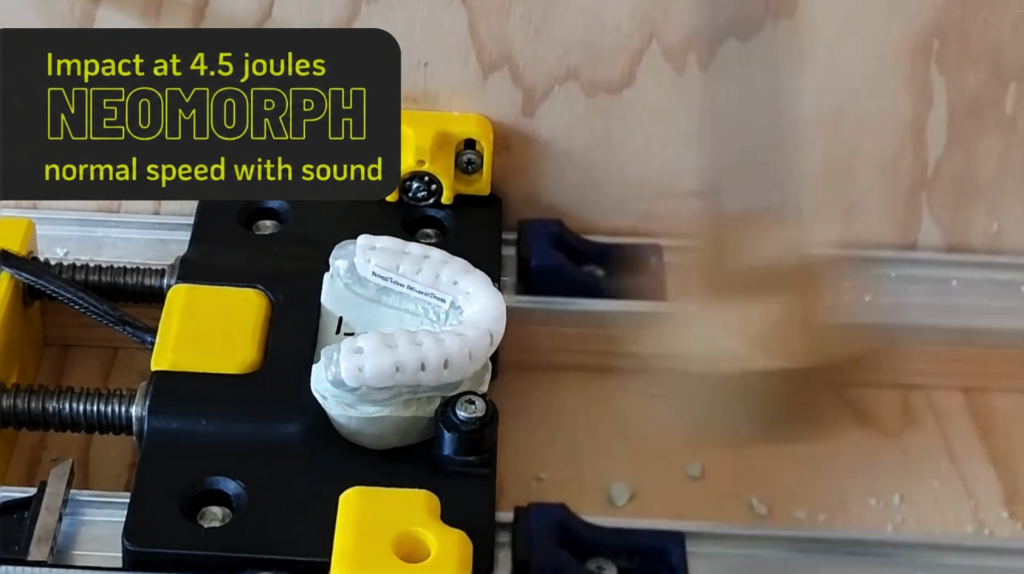
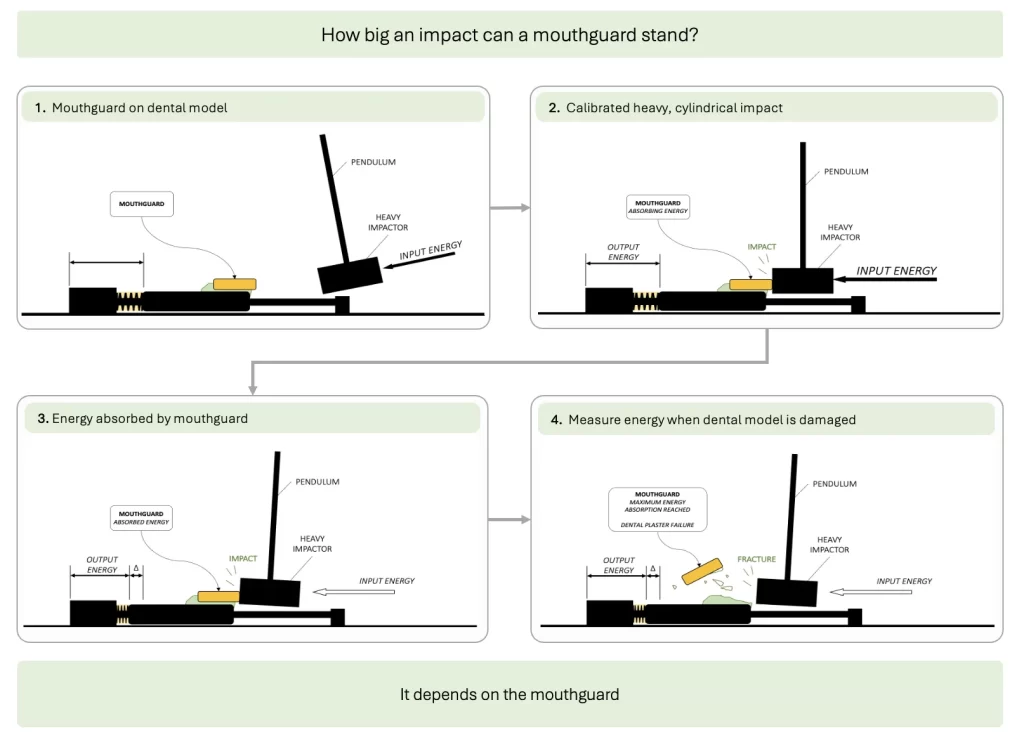
Testing was performed using a purpose-built pendulum impact apparatus designed to deliver a consistent frontal impact to the upper front teeth.
The pendulum used:
• a heavy brass cylindrical impactor
• and a custom clamping chuck system that precisely positioned and retained the plaster dental model during impact
By standardising:
• the impact location
• the force direction
• the positioning
• and the model retention
each impact remained highly controlled and repeatable throughout testing.
Every impact delivered by the apparatus remained the same across all tests, with the type of mouthguard and the impact force remaining the only significant variables.
What Happens Without a Mouthguard?
In the absence of a mouthguard, the dental plaster cast chipped with extremely small impacts. In fact, the impact tolerated by the model without protection was too low to reliably measure.
This demonstrated how vulnerable unprotected teeth can be during sporting impact.
Destructive Testing: Measuring Mouthguard Failure
To assess protective capacity, the pendulum angle was gradually increased. As the pendulum height increased, so too did the impact energy delivered to the mouthguard and underlying dental model.
Each mouthguard replicate was tested repeatedly until the dental model chipped or fractured. This process is known as destructive or failure testing.
The maximum impact available from the test stand was 8.75 Joules, which caused dental model fracturing in nearly all mouthguards tested.
Using multiple matched replicates enabled:
• repeated testing
• comparative analysis
• and statistical evaluation between mouthguards
This provided a comparative measure of overall “protective capacity.”
How Impact Absorption Was Measured
In addition to destructive testing, the study also assessed how much energy each mouthguard absorbed during impact.
The testing evaluated:
• how energy transferred through the mouthguard
• how force moved into the teeth and jaw
• and how effectively impact was distributed and dissipated
Any energy not absorbed by the mouthguard transferred into:
• the teeth
• jaw structures
• and surrounding tissues
This is why both energy absorption and load distribution play important roles in mouthguard performance.
The calibration of the pendulum and clamping system also allowed researchers to compare how mouthguards behaved at varying impact levels and how effectively forces were distributed around the jaw.
What Did the Sports Mouthguard Impact Testing Show?
Dental damage occurred for all types of mouthguards at varying levels of impact. However, the degree of protection differed significantly between mouthguards.
Poorly protective mouthguards:
• absorbed very little energy
• allowed damage at relatively small impacts
• and concentrated force onto the front teeth
Better-performing mouthguards generally:
• absorbed more energy
• withstood larger impacts
• and distributed forces more effectively around the jaw
The sports mouthguard impact testing demonstrated that mouthguard protection is influenced by multiple factors, including:
• fit
• material
• construction
• impact absorption
• and force distribution characteristics
These factors are part of the broader variables and limitations that influence mouthguard protection.
What the Results Reinforced for NeoMorph
One of the key observations from the testing was that mouthguard performance is not determined by thickness alone.
The testing demonstrated that better-performing mouthguards were generally those that:
• absorbed more impact energy
• distributed force more effectively
• and maintained stability during impact
These findings highlighted that mouthguard performance is influenced by multiple factors and not simply thickness alone.
This reinforced many of the same challenges our founder had observed clinically over many years working with sports people and orthodontic patients.
Many traditional over-the-counter mouthguards can feel:
• bulky
• uncomfortable
• poorly fitting
• and do not re-mould particularly well for changing dentitions such as braces and aligners.
Many sportspeople are looking for a re-mouldable OTC alternative that sits between traditional boil-and-bite mouthguards and dental-made mouthguards.
NeoMorph was developed with this balance in mind:
• secure fit
• re-mouldability
• comfort
• retention
• and impact performance
The independent testing formed an important part of validating that approach.
Rather than focusing on a single factor such as thickness alone, NeoMorph’s development philosophy has always centred around the broader relationship between:
• fit
• force distribution
• impact absorption
• comfort
• and long-term wearability
Secure fit is also an important part of keeping a mouthguard correctly positioned during sport — learn more about the importance of a properly fitting mouthguard.
Because ultimately, a mouthguard only works properly if athletes are willing to consistently wear it.
Readers interested in reviewing the detailed testing results and comparative performance data can view our full Testing Results page.
Learn More About NeoMorph
Interested in learning more about NeoMorph’s approach to fit, comfort and protection?
Explore our educational resources, fitting guides and product information at Neomorph Mouthguards.
Secure custom fit. Comfortable to wear. Protection you can trust.
Visit neomorphmouthguards.com
About the Author
Amanda Trenerry is the Founder of NeoMorph Mouthguards and a Dental Hygienist with more than 30 years of clinical experience and over 38 years in the dental profession. Her experience spans across general dentistry, orthodontics, prosthodontics and dental education in both Australia and the UK. Amanda has spent much of her career educating patients about oral health and sports mouthguards and is passionate about improving access to comfortable, protective mouthguards for all athletes.

Disclaimer: This article is based on the professional experience and opinions of Amanda Trenerry, Founder of NeoMorph Mouthguards, gained through more than 30 years working within the dental profession, including extensive experience in orthodontics. The information is provided for educational purposes only and should not be relied upon as individual clinical advice. Patients should consult their own dental or orthodontic practitioner regarding their specific treatment and mouthguard requirements.